Bilbao - A City of Contrasts
There are few cities in the world that are as astonishing as Bilbao. Its contrasts, its gastronomy, the combination of an elegant past and a contemporary present make it irresistible. Today of course, the star attraction is the Guggenheim Museum but there is so much more to Bilbao than that.
The city established itself as a significant port in the middle ages, despite being several miles up a meandering estuary flanked by high hills. The problems of bringing sailing ships in and out must have been considerable. I take a special interest in Bilbao's role as a trading port as one of my family, Robert Melhuish (Roberto Melyusse in the Spanish archives), was a wool trader here in about 1700.
Then at the end of the 19th century Bilbao became an important industrial town, based on the iron industry. Like all such places around the world, it benefited from the four key ingredients all being nearby: iron ore, coal, limestone and transport.
The modern city centre was laid out in about 1890, which explains the carefully planned broad avenues which contrast so vividly with the cramped jumble of the old town (the "Siete Calles" or "Seven Streets"). The modern city has stood the test of time well, and the wide streets, parks and plazas are a pleasure to pass along.
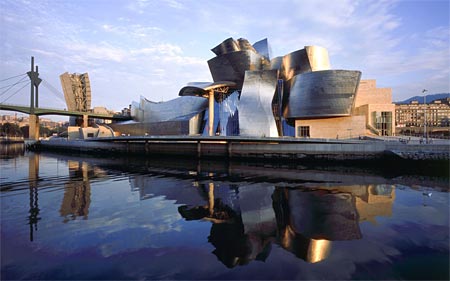 The key feature of post-industrial Bilbao was the decision to build the Guggenheim Museum Bilbao on the banks of the Nervion river. This huge and ambitious project designed by architect Frank Gehry single-handedly transformed Bilbao into an artistic tourist destination. The modern art collection of the Solomon R Guggenheim Foundation draws visitors from all over the world, then once they have arrived they see how much more Bilbao has to offer.
Having had their fill of the Guggenheim, some visitors will want to see the more traditional art collection at the Museum of Fine Arts, while others may decide it is time to venture outside to stroll along the river to the Teatro Arriaga and the Casco Viejo (old town), returning along the grand central spine of the city, the exuberantly named Gran Via de Don Diego Lopez de Haro.
A short distance from the city centre there is more to see. A short distance down the river is the Puente Colgante, the world's first transporter bridge and still in regular use. 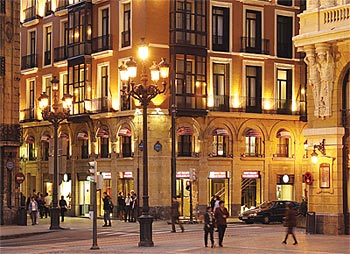 Another short step leads to Las Arenas, Bilbao's nearest beach and also the place to view many fine houses built for Bilbao's elite in the early 20th century. Beyond that, the old village of Getxo houses some excellent seafood restaurants.
For students of history, the Basque Country Museum in the old town is a must, and that could be followed by a trip up the funicular railway to the old mining village at Trapagaran.
The coastline to east and west of Bilbao is spectacular, and it would be invidious to pick out any one place at the expense of another. Suffice to say that a slow drive in either direction will bring beaches, cliffs, villages and scenery aplenty. Nor is it just the coast which is pleasing on the eye: a drive inland in almost any direction will again bring hills, mountains, valleys, woods and streams that cannot fail to satisfy the senses.
Anyone with half an interest in art will of course know the name Guernica. Pablo Picasso's painting portrays the appalling bombing attack on the undefended town during the Spanish Civil War. The museum naturally houses a replica of the painting but the real interest in Guernica today is the meeting house of the traditional Basque Parliament.
Written by Paul Melhuish.
For a luxurious stay in a contemporary Bilbao hotel, try Miro Hotel Bilbao.
Alternative hotels just outside the city: Palacio Urgoiti, Hotel Katxi or Hotel Gametxo.
See also this blog post about the Basque language.
5 Feb 2016, 18:12